How Length Conversion Works
A length conversion multiplies a measurement by a unit ratio equal to one. The quantity stays the same while its numerical value and unit change.
Preserve the quantity, change the label
Five meters and about 16.404 feet describe the same length. The number changes because the target unit has a different size, not because the physical quantity changes.
Build a conversion factor
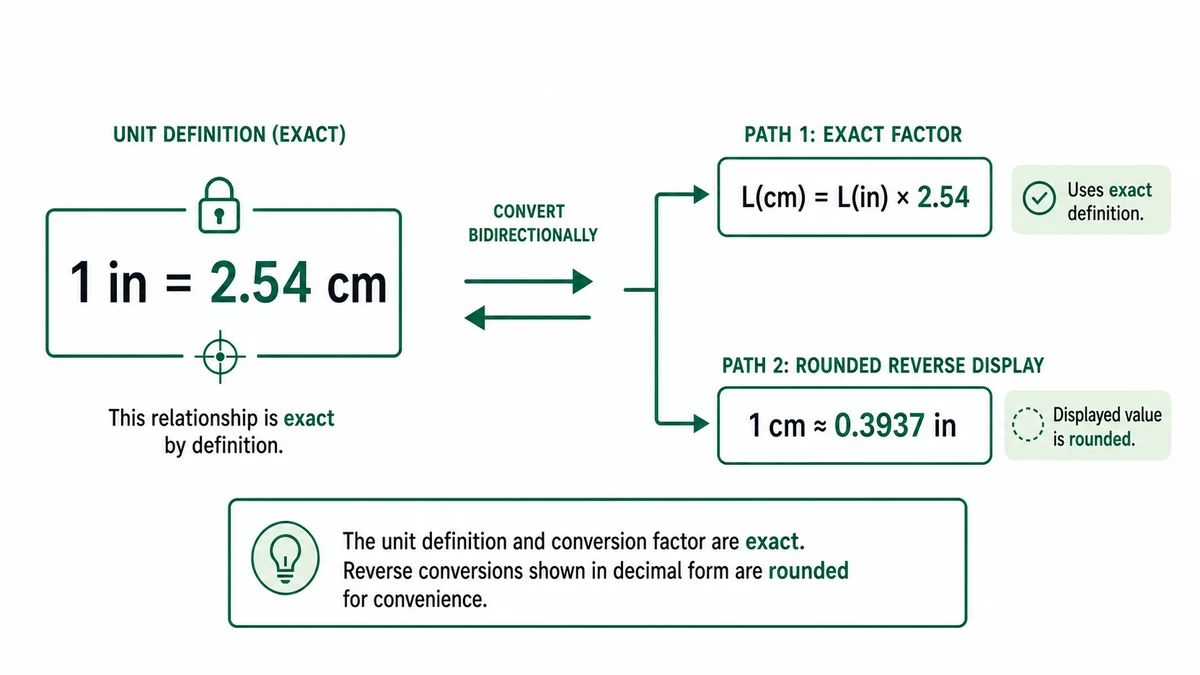
Start from a known equality, such as 1 inch = 25.4 millimeters. Arrange the ratio so the source unit cancels. For inches to millimeters, multiply by 25.4 mm / 1 in.
For a reverse conversion, invert the factor. This is safer than memorizing two unrelated decimals because the direction remains visible in the written units.
Three fast checks
A calculator can evaluate arithmetic, but a reasonableness check validates the setup.
- Unit check: the source unit should cancel and the target unit should remain.
- Direction check: converting into a smaller unit should usually produce a larger number.
- Scale check: compare with a familiar anchor such as 1 in = 2.54 cm or 1 mi ≈ 1.61 km.
Questions about this topic
Why does the number change during conversion?
The unit size changes. A smaller target unit requires more units to describe the same length.
Can I always reverse a conversion by dividing?
Yes, when you divide by the same nonzero factor used in the forward multiplication. Writing the unit ratio helps confirm the direction.