Metric Prefixes and Place Values
Metric prefixes scale a unit by powers of ten: milli is 10⁻³, centi is 10⁻², and kilo is 10³. Convert by comparing the prefix powers and moving the decimal by their difference.
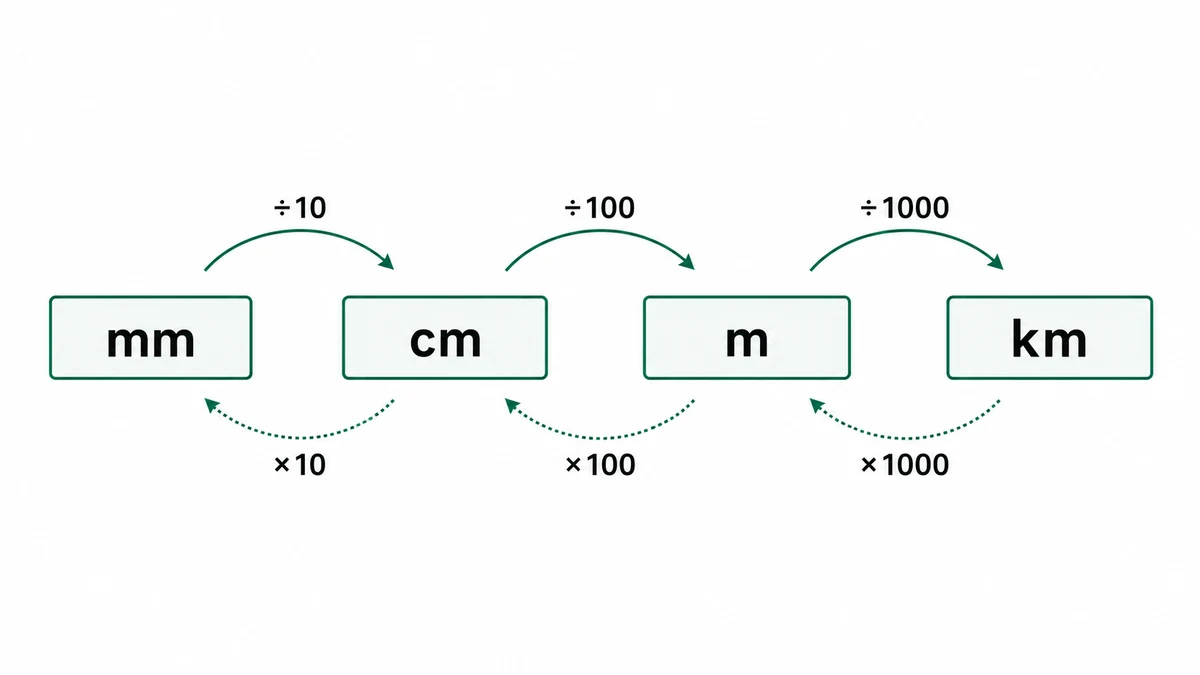
The meter as the reference point
A prefix attaches to the meter and changes its magnitude. It does not create a different kind of measurement: every value still represents length.
| Unit | Power of ten | Meters |
|---|---|---|
| millimeter (mm) | 10⁻³ | 0.001 m |
| centimeter (cm) | 10⁻² | 0.01 m |
| meter (m) | 10⁰ | 1 m |
| kilometer (km) | 10³ | 1,000 m |
Use the exponent difference
To convert kilometers to millimeters, compare 10³ with 10⁻³. The difference is six powers of ten, so multiply by 10⁶. In the reverse direction, divide by 10⁶.
Writing the unit beside every intermediate number makes the direction visible and helps catch a decimal moved the wrong way.
Check the direction
The same physical length needs a larger number when expressed in a smaller unit. If 2 meters becomes 0.02 centimeters, the direction check immediately reveals the mistake.
- Larger unit to smaller unit: the number increases.
- Smaller unit to larger unit: the number decreases.
- Trailing zeros may express precision, so preserve them when measurement certainty matters.
Questions about this topic
How many millimeters are in a kilometer?
There are exactly 1,000,000 millimeters in 1 kilometer.
Does centi mean 100?
Centi means one hundredth, or 10⁻², when used as an SI prefix.