Metric vs. Imperial Length Units
Metric length uses powers of ten around the meter. Imperial and US customary length uses relationships such as 12 inches per foot, 3 feet per yard, and 1,760 yards per mile. Exact definitions connect the systems.
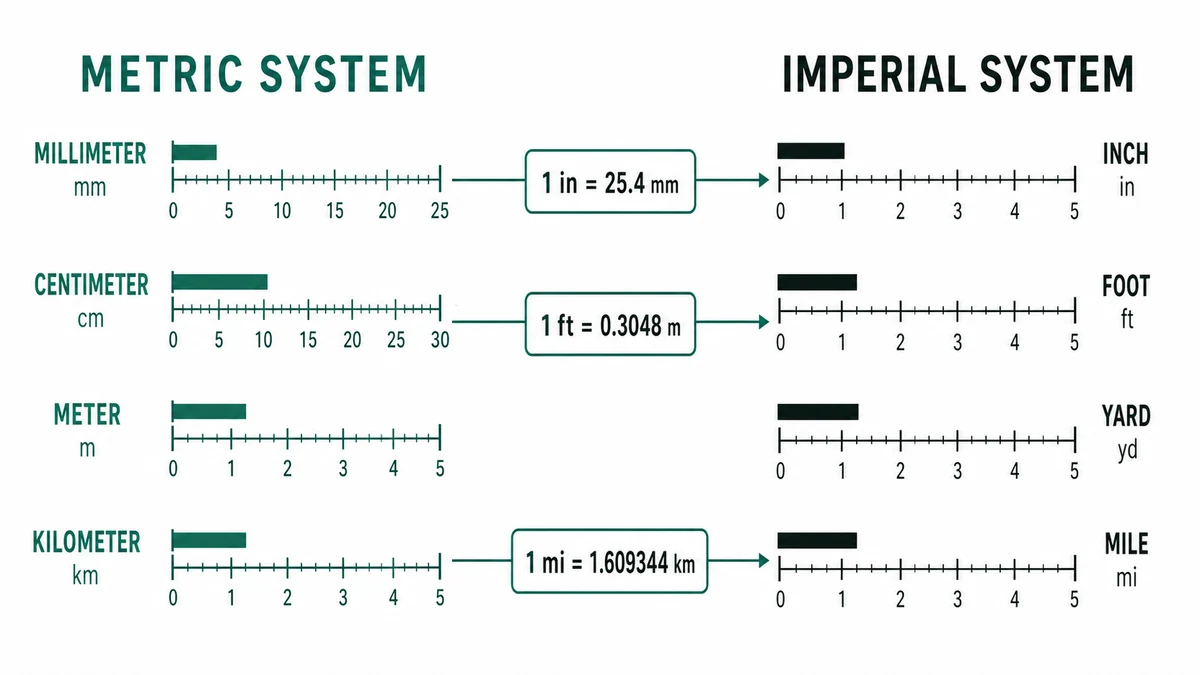
Two different scaling patterns
Metric units share a decimal structure. Prefixes tell you the power of ten, so converting between millimeters, centimeters, meters, and kilometers is mainly a place-value operation.
Imperial and US customary units use several whole-number relationships. An inch ruler is commonly fractional, a foot contains 12 inches, a yard contains 3 feet, and a statute mile contains 1,760 yards.
| Scale | Metric | Imperial or US customary |
|---|---|---|
| Small | millimeter, centimeter | inch |
| Human scale | meter | foot, yard |
| Long distance | kilometer | mile |
How the systems connect
The international inch is exactly 25.4 millimeters. The foot, yard, and statute mile therefore also have exact meter values. Decimal results may still repeat, so a displayed answer can be rounded even when the underlying relationship is exact.
Choose the system required by the drawing, standard, audience, or measuring tool. When exchanging measurements, include both the number and unit symbol to prevent ambiguity.
Practical conversion choices
Use an exact factor for specifications, purchasing, manufacturing, and cumulative calculations. Mental shortcuts are useful for checking whether a result is in the right range.
- Inches to centimeters: multiply by 2.54.
- Feet to meters: multiply by 0.3048.
- Miles to kilometers: multiply by 1.609344.
- For a quick miles-to-kilometers estimate, multiply by about 1.6.
Questions about this topic
Is metric more accurate than imperial?
No unit system is inherently more accurate. Accuracy depends on the measuring method, calibration, resolution, and reporting.
Are metric-to-imperial conversions exact?
Conversions based on the international inch are exact in definition, although their decimal display may need rounding.